
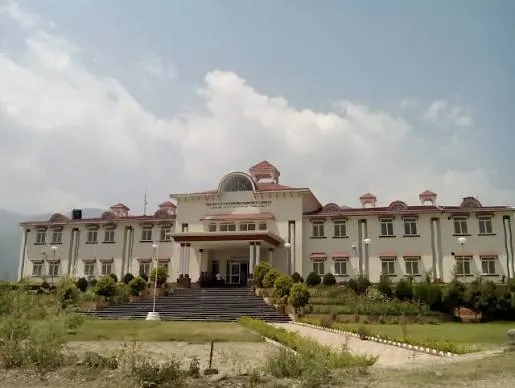
THDC Institute of Hydropower Engineering & Technology (Constituent College of Uttarakhand technical University)
THDC Institute of Hydropower Engineering & Technology (Constituent College of Uttarakhand technical University) is an engineering institution in Tehri Garhwal, Uttarakhand, affiliated to Uttrakhand Technical University, Dehradun, established in 2011.
Accreditation
The institute came into existence in 2011 through a Memorandum of understanding between THDC-IL and UTU to meet the requirement of credible engineers in the field of Hydropower and renewable energy. THDC-IHET has since embarked upon a journey of producing highly qualified technocrats in the field of engineering and Technology. THDC-IHET is the only hilly region technical institute that is industry supported by a well known PSU of energy Sector, THDC India Ltd. The campus of institute is spread across a mighty twenty acres green land and known for its rich infrastructure. What makes this institute different from others is its lush green campus and pollution free environment. The campus is beautiful and ideally suited for the students interested in technical education the campus of THDC-IHET not only provides a tranquil place but abundance of greenery makes it an ideal place for studies as well. Moreover, the institute is situated near Tehri Lake which has become the most beautiful sight seeing and a water adventure sports hub for travelers. The institute provides grand Infrastructure, well equipped labs, modernized classrooms, computer centre, seminar hall and a fully automated library. In addition best possible facility of hostel, sports, gym, canteen and transportation are offered. Well qualified faculties of the institute provide best educational, research and professional environment. Dr. Sharad K. Pradhan is working as Director, at the THDC-Institute of Hydropower Engineering and Technology, Tehri. Earlier he was a Professor, Mechanical Engineering, Dean, Corporate & International Relations, and Associate Director, of NITTTR Bhopal-Siemens Center of Excellence at the National Institute of Technical Teachers’ Training and Research (NITTTR), Bhopal. He did his Ph.D. from the Mechanical Engineering Department, Indian Institute of Technology (IIT), Delhi and before joining NITTTR Bhopal he was a Scientist in ‘Design & Simulation Group’ at ‘Central Mechanical Engineering Research Institute’ (CMERI), Durgapur, (WB).
2011
Established
government
Ownership
Engineering
Type
Tehri Garhwal
Uttarakhand
Affiliation
Uttrakhand Technical University, Dehradun
The institution is dedicated to continuously planning, promoting, and sustaining a high quality of integrated education and research. It focuses on grooming students into elite, highly skilled professionals who serve as valuable assets for industry, academia, and global organizations. By constantly investing in collaborative research on hydropower and alternate energy systems alongside leading corporate partners, the institute benchmarks itself against strict international standards. Ultimately, it seeks to serve society by maintaining an organizational culture of baseline excellence nurtured thoroughly by ethical
The institute aspires to be a globally admired institution of education and research, specifically focusing on hydropower and other sustainable energy resources. It aims to cultivate a world-class learning environment that bridges traditional engineering with future-ready, clean energy breakthroughs.
Students
Programs Offered
Contact Details
Bhagirthipuram,,Tehri
Tehri Garhwal, Uttarakhand - India
Admission Process
Admissions to the B.Tech programs are completely centralized and structured through state-level online counseling rounds administered by the Uttarakhand Technical University (UTU), which strictly assigns candidate seats on the basis of their All India Rank (AIR) in the Joint Entrance Examination (JEE Main) combined with intermediate percentages. If vacant slots remain unallocated at the conclusion of primary counseling cycles, the institution conducts on-campus direct institutional counseling or spot rounds, filling remaining vacancies via direct 10+2 merit scores. The conclusive validation of any student's branch allocation remains subject to immediate physical documentation verification and mandatory structural institutional fee submission directly at the Tehri campus administrative block.
Eligibility Criteria
For undergraduate admission to the regular 4-year B.Tech programs (Computer Science, Civil, Electrical, Electronics & Communication, and Mechanical Engineering), candidates must have passed their 10+2 (Intermediate) examination or its equivalent from a recognized board, choosing Physics and Mathematics as mandatory subjects along with one elective technical subject (such as Chemistry, Biotechnology, Computer Science, or Biology) while scoring a minimum aggregate of 45% marks (40% for candidates belonging to statutory SC/ST/OBC reserved categories). For B.Tech Lateral Entry directly into the second year, applicants are required to possess a state-technical-board recognized 3-year Engineering Diploma or a B.Sc. degree with specified mathematical benchmarks. Regular seats are heavily apportioned to bonafide domicile residents of Uttarakhand under state reservation mandates, with remaining unallocated openings handled through institutional or national quotas.